
VERA: the New Generation of Displays for Flight Testing on the 777-9
By Captain Bassani - ATPL/B-727/DC-10/B-767 - Former Air Accident Inspector SIA PT. captbassani@gmail.com - OCT/2025 - https://www.personalflyer.com.br/
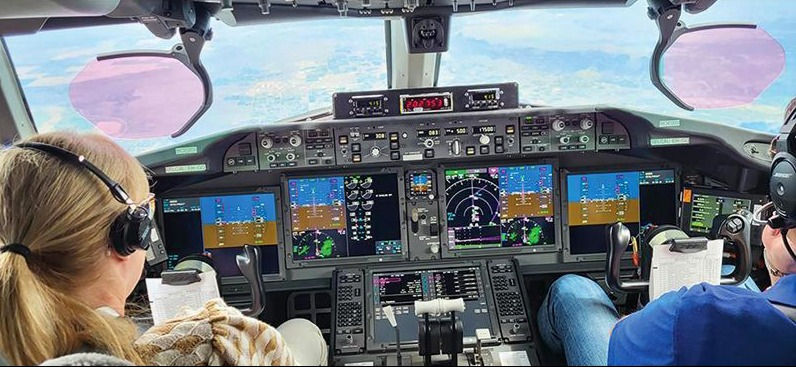
Image Boeing media promo
Boeing is introducing an innovative system called VERA in the 777-9 flight tests, with the goal of increasing efficiency, accuracy, and the first-time success rate of critical maneuver trials.
What is VERA
VERA stands for Visually Enriched Rendering Application. It integrates flight test data in real time directly into the Primary Flight Display (PFD), instead of relying on separate auxiliary displays.
The system projects test parameters (such as G-load, bank angle, control surface deflection, etc.) using colors, icons, and symbology already familiar to pilots, consistent with Boeing’s display philosophy.
VERA is activated via a rotary switch that replaces the standard PFD view with a visually enriched flight test mode.
Expected gains / benefits
Increase in first-time test success rate - Before VERA, Boeing estimated that around 70% of flight tests were successfully completed on the first attempt, with the remainder requiring repetition. With VERA, the initial target is to raise this rate to 85%, with projections reaching up to 98%.
Improved situational awareness - By displaying critical maneuver parameters directly on the main display, pilots no longer need to reference multiple auxiliary systems, reducing decision-making time and cognitive workload.
Reduction in repeated tests and associated costs - Fewer repetitions mean less dedicated flight test time, fewer flight hours for certification, and overall resource savings.
Implementation on the 777-9
VERA has been integrated into the 777-9 test flights and has also been applied to the 737-10 program.
Boeing repurposed an existing redundant fiber-optic link in the aircraft’s display architecture to channel test data into the PFD, eliminating the need for heavy auxiliary hardware.
The design leverages compatibility with Boeing’s display philosophy, using coherent colors and alerts aligned with the rest of the avionics system.
Challenges and considerations
Pilot and test engineer adaptation to correctly interpret new visuals and symbology.
Safe integration without compromising normal flight systems (even when in test mode).
Ensuring VERA does not interfere with existing safety protocols and redundancies during flight testing.

Image Boeing media promo
Perspectives
Boeing is expected to continue refining VERA based on the results obtained during the 777-9 test campaign, with the prospect of introducing variants in other flight programs such as the 737-10 and the future 777-8F freighter. From a regulatory standpoint, authorities such as the FAA and EASA will closely monitor the use of real-time overlays on the Primary Flight Display (PFD) for flight testing, assessing their impact on pilot workload, the robustness of certification data, and overall operational safety, requiring documented safety cases.
If VERA maintains “first-time success” rates close to the established targets, there is potential to reduce test hours and associated costs, as well as to improve predictability in certification schedules. However, the system does not eliminate core regulatory steps nor replace compliance verifications, but it may represent a significant advance in efficiency and risk control during test campaigns.
Safe Flights!
Sources:
Boeing – High Five: Fifth 777-9 takes flight
Boeing – 5 in flight: See the full 777-9 fleet in action
Boeing – página oficial do programa 777X By Design
Aviation Week & Space Technology — “Boeing Improves 777-9 Flight-Test Execution With New Pilot Display” (Guy Norris, 25 setembro 2025)
Airspace Economy — “Boeing 777-9 Flight Test Improvements, VERA Display 2025”
Wings of Knowledge Collection – International Release
 |  |  |  |
In the next two months, the first two volumes of this 18-book collection will be available for online purchase in Portuguese and English, already positioned as a reference for aviation professionals and enthusiasts:
Volume 1 – Introduction to Aviation and the Role of the Pilot
Volume 2 – Human and Physiological Factors in Flight Safety
More than books, these guides represent a true transformation in the training and development of aviation players — whether cadets, experienced pilots, instructors, safety managers, or enthusiasts. They provide a solid path to mastering the art and science of flying, integrating technical fundamentals, human factors, international best practices, and a forward-looking vision.
An indispensable collection for those who pursue excellence and safety in the skies.


Comentários