
Cognitive limits in the cockpit: how far can the pilot really go during takeoff or approach?
By Captain Bassani - ATPL/B-727/DC-10/B-767 - Former Air Accident Inspector SIA PT. captbassani@gmail.com - Feb/2026 - https://www.personalflyer.com.br
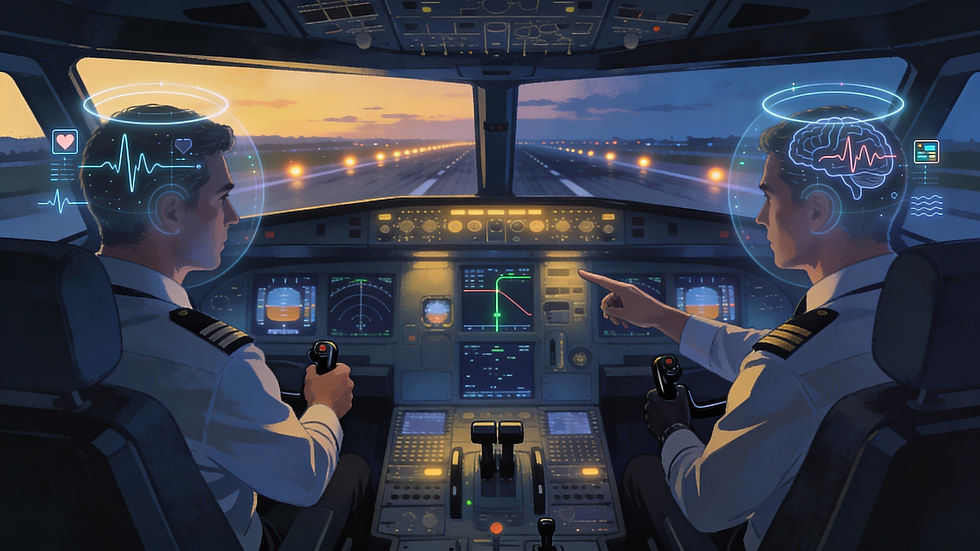
Two first officers undergoing simulator training - image AI.
Operating medium and large transport aircraft during takeoff and approach pushes the pilot’s brain very close to its practical cognitive limit, even in highly automated environments. Recent Airbus A320 simulator studies show that landing, followed by takeoff, are the phases with the highest mental workload, the greatest suppression of heart rate variability (HRV – Heart Rate Variability), and the worst performance scores, while cruise is associated with physiological recovery and better decision‑making. Put simply: it is precisely when we most need fine judgment and broad situational awareness that the cognitive system is under the greatest pressure.
Classic NASA studies and work by researchers associated with the Royal Aeronautical Society indicate that, as the sum of tasks approaches maximum capacity, performance remains stable for a time but then degrades abruptly, with an increase in omission errors, attentional narrowing, and loss of monitoring. Research using secondary reaction‑time tasks and scenarios with increasing levels of automation shows that, under high workload, pilots begin to drop peripheral tasks (monitoring of secondary instruments, some communications, some checks) in an effort to preserve basic trajectory control. In a highly automated cockpit, when automation is not intuitive, this becomes worse: managing multiple modes itself starts to consume significant cognitive resources.
Recent work using HRV, EEG (Electroencephalogram / Electroencephalography) and machine‑learning models in civil and military pilots reinforces the finding that there is a workload threshold beyond which the ability to integrate multiple information sources breaks down. Studies of aircraft traffic‑pattern operations show that landing demands the highest information‑processing density — simultaneous management of descent rate, centerline alignment, energy state, parameter monitoring, and go‑around readiness — and that, in this phase, HRV is most suppressed and average performance drops. In parallel, FAA/NASA research with business jets (such as the Citation Mustang) shows that, in high‑workload IFR events, errors like speed/altitude deviations and incorrect readbacks become frequent when just one additional critical task is added on top of what is already required to fly, navigate, communicate, and manage automation.
From the perspective of flight deck design and airline SOPs (Standard Operating Procedures), the message is clear: the “limit” is not a fixed number of systems or checklists, but the point at which the sum of simultaneous tasks prevents three central functions — maintaining global situational awareness, prioritizing correctly attitudes, and executing to a minimum standard of quality. For this reason, authorities and research groups recommend automation design that truly reduces, rather than increases, cognitive load in critical phases; strong standardization of takeoff and approach tasking; and the use of “tactical pause” techniques (time‑outs, formal cross‑checks, explicit verbalization of options) to create deliberate windows for reassessment. In addition, recent studies point to real‑time monitoring solutions (HRV, eye‑tracking, physiological signals) that can feed adaptive automation, modulating alerts and priorities as the pilot approaches this cognitive saturation.
For captains and first officers of medium and large transport aircraft, this translates into two complementary responsibilities: operating the aircraft within published limits, and operating their own cognitive capacity within realistic limits. In practice, this means consciously protecting takeoff and approach from non‑essential tasks, managing automation strategically, using CRM to distribute workload, and accepting that, above a certain level of complexity, simplifying the plan (go‑around, vectors, holding) is often the most professional decision.
Safe flights
Captain Luiz Bassani
Fontes
NASA – “Pilot Workload and Fatigue”.
Kantowitz et al. – “Pilot Workload and Flight Deck Automation”, Royal Aeronautical Society / SAE.
Norman, S. – “Flight Deck Automation: Promises and Realities”, NASA.
Zhang et al. – “Pilot mental workload analysis in the A320 traffic pattern based on HRV and machine learning”.
Estudos sobre carga cognitiva objetiva em pilotos (EEG, HRV, ML).
Burian et al. – “Single-Pilot Workload Management in Entry-Level Jets”, FAA / NASA Flight Cognition Lab.
WINGS OF KNOWLEDGE SERIES
 |  |  |  |
They are now available for online purchase, in Portuguese and English, the first volume of this 18-book series, which is already emerging as a reference for aviation professionals and enthusiasts:
Volume 1 – Introduction to Aviation and the Role of the Pilot
Volume 2 – Human and Physiological Factors in Flight Safety – Release: February 6, 2026
Volume 3 – The Importance of Aeronautical Knowledge – April 2026
More than books, these guides represent a true transformation in the education and development of aviation professionals, from cadets to experienced pilots, instructors, safety managers, and dedicated enthusiasts.
They provide a structured path toward mastering the art and science of flight, integrating technical fundamentals, human factors, internationally recognized best practices, and a forward-looking perspective.


Comentários