
When Altitude Information Is Unreliable - The Operational Risks of Air Data System Discrepancies
By Captain Bassani - ATPL/B-727/DC-10/B-767 - Former Air Accident Inspector - SIA PT. https://www.personalflyer.com.br - captbassani@gmail.com - Apr/2026
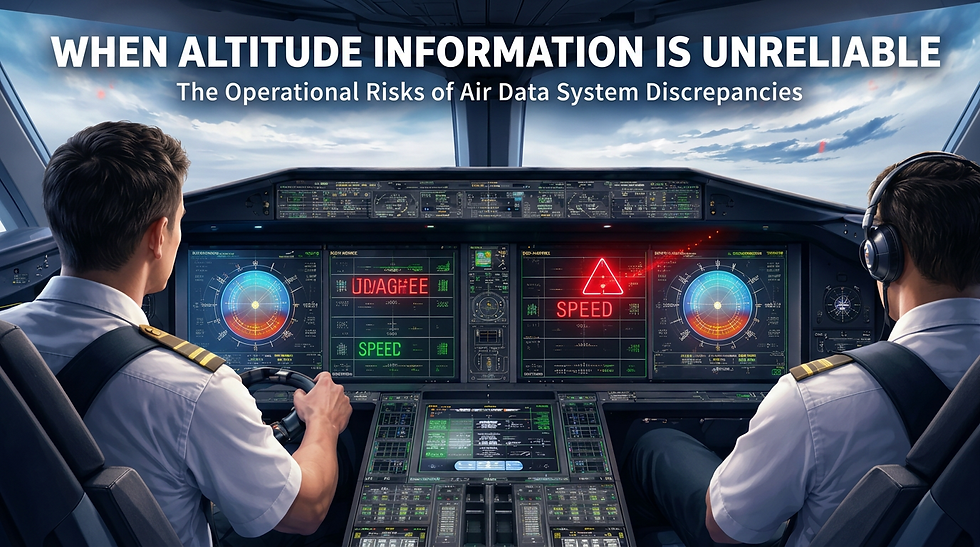
Image AI Perplexity
In modern aviation, we trust our instruments until they no longer reflect physical reality. When the air data system provides conflicting or erroneous information, the aircraft may appear perfectly normal in the cockpit while actually operating with inconsistent critical flight parameters.
This is where one of the most dangerous forms of situational awareness degradation begins: the pilot sees valid-looking data, but it no longer represents the real state of the aircraft.
The problem can originate from multiple sources: pitot or static port blockage, icing, insect contamination, Air Data Computer (ADC) mismatch, barometric setting errors, or common-mode failures not readily detected by standard cross-checks. The EASA has highlighted that erroneous air data may also propagate to systems feeding the transponder and ACAS (TCAS), meaning the error is not confined to the PFD, it can affect the aircraft’s surveillance and collision avoidance architecture.
The BEA has emphasized another less visible but equally critical risk: QNH error. In recent investigations, a deviation of only 10 hPa during an approach based on barometric altitude resulted in a flight path approximately 280 ft below the published profile, with the crew unaware of the deviation until proximity to terrain. The key point is straightforward: in procedures based on barometric altitude, the aircraft may be consistent with instrument indications and still incorrect relative to the real environment.
For this reason, the safety community continues to treat this topic with high priority. The BEA, EASA, Airbus and other stakeholders consistently reinforce that QNH validation, independent cross-checks, awareness of Baro-VNAV limitations, and disciplined approach procedures are essential safety barriers, but not infallible ones. When altitude information is incorrect, the operational context can rapidly degrade into controlled flight into terrain (CFIT), unstable approach, or loss of control due to misinterpreted energy state and trajectory cues.
A key investigative insight is that discrepancies do not need to be large to be hazardous. Even small deviations, particularly during approach, can trigger incorrect decisions, automation misinterpretation, delayed alerts, and a false sense of precision. In complex operations, the risk lies not only in sensor failure, but in overconfidence in data that has lost internal consistency.
The future direction of aviation safety is evolving along three main fronts:
More robust detection of air data discrepancies and flight control or automation mode inconsistencies, supported by improved onboard monitoring logic.
Greater emphasis on training for unreliable airspeed, altimetry, and barometric setting errors, especially during approach.
Stronger integration of safety data, human factors, and engineering, recognizing that these events are rarely purely technical, they emerge from the interaction between system, environment, and human decision-making.
The conclusion is clear.
When altitude information is incorrect, the cockpit can still appear fully credible, and that is precisely what makes the risk so insidious. The pilot’s task is to challenge apparent normality, verify data consistency, and recognize early that, at certain moments, the right question is not:
“what does the instrument show?” but “what is no longer operationally consistent?”
Safe flights!
Captain Luiz BASSANI
If this content contributes to your operational awareness, share it with your peers.
By spreading technical knowledge among pilots, we extend the safety culture beyond a single cockpit.
Each useful piece of information shared helps strengthen flight safety across aviation worldwide.Safe flights!
Sources
SKYbrary –Unreliable Airspeed Indications e Altimetry System Error.
EASA SIB –Operational procedures for air data loss or erroneous air data.
Flight Safety Foundation –Air Data Spikes Trigger Upset.
EASA / FlightGlobal on air-data failure and control-law detection.
NASA/FAA on performance data errors and human factors.
BEA investigation material on incorrect QNH / barometric approach risk.
Airbus Safety First –Use the Correct BARO Setting for Approach.
WINGS OF KNOWLEDGE SERIES
Take your aviation knowledge to the next level, secure your copies today! The first and second volumes of this 18-book series are now available online in Portuguese and English. Don’t miss the chance to access the reference guides that pilots, instructors, and aviation professionals are already using to advance their skills and understanding. Click on image!
 |  |  |  |
They are now available for online purchase, in Portuguese and English, the first volumes of this 18-book series, which is already emerging as a reference for aviation professionals and enthusiasts:
Volume 1 – INTRODUCTION TO AVIATION AND THE ROLE OF THE PILOT - Available on Amazon
Volume 2 – HUMAN AND PHYSIOLOGICAL FACTORS IN FLIGHT SAFETY - Available on Amazon
Volume 3 – AIRCRAFT SYSTEMS – TECHNICAL AND OPERATIONAL FOUNDATIONS FOR PILOTS – Jun 2026
More than books, these guides represent a true transformation in the education and development of aviation professionals, from cadets to experienced pilots, instructors, safety managers, and dedicated enthusiasts.
They provide a structured path toward mastering the art and science of flight, integrating technical fundamentals, human factors, internationally recognized best practices, and a forward-looking perspective.


Comentários